
ASDL and the U.S. Endowment for Forestry and Communities Partner on Forestry Residues Study
ASDL and the U.S. Endowment for Forestry and Communities Partner on Forestry Residues Study
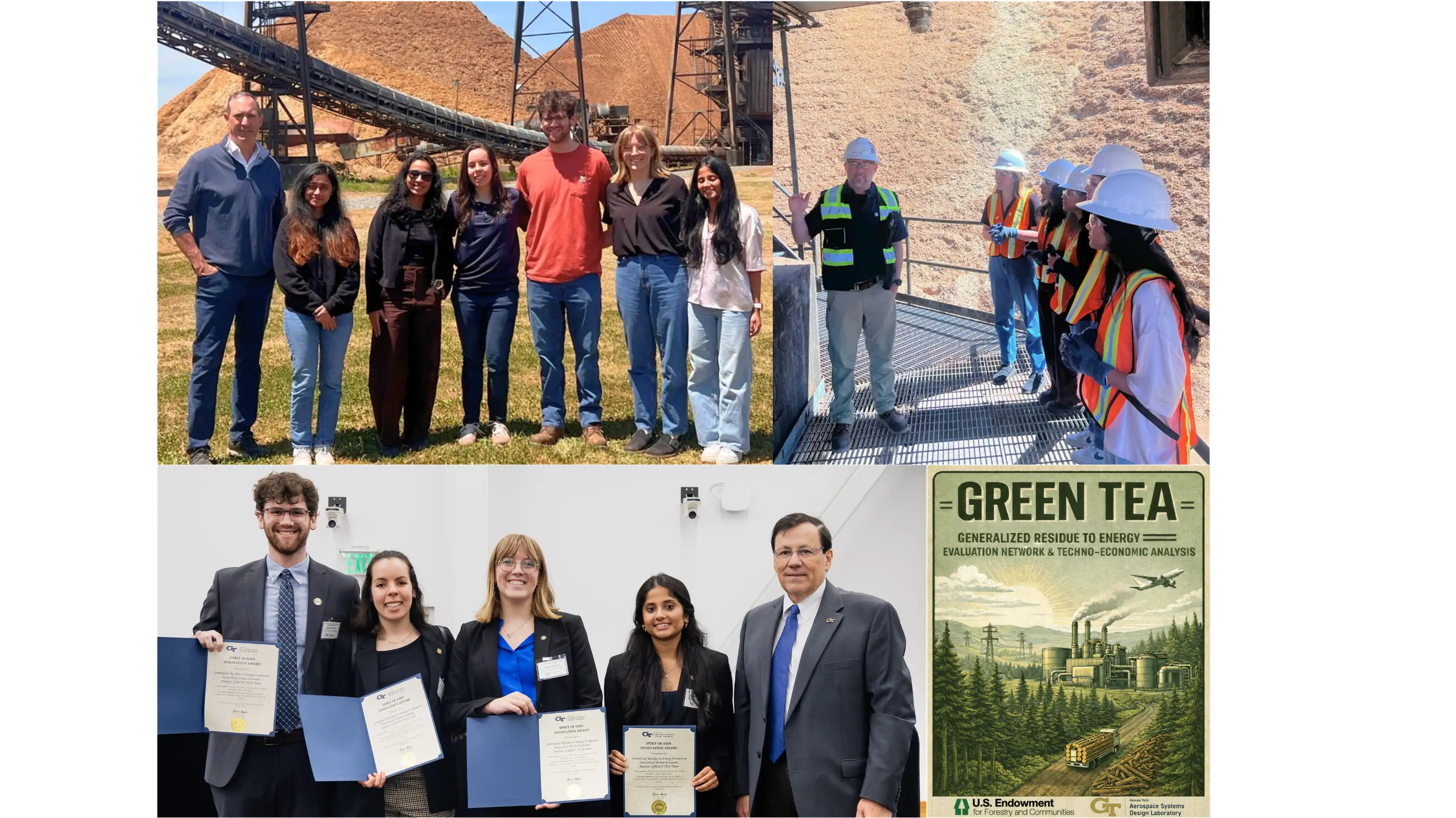
As part of a new partnership between Georgia Tech and the U.S. Endowment for Forestry and Communities, a team of graduate students in the Aerospace System Design Laboratory (ASDL) have completed a study exploring how underused forest fiber can support new energy markets after pulp and paper mill closures.
The team examined pathways for turning forestry residues into biomass power, renewable diesel, and sustainable aviation fuel, with a focus on rural communities affected by the loss of traditional pulp and paper markets. They also developed a prototype decision-support tool to help communities, investors, and policymakers compare scenarios across feedstock supply, costs, policy incentives, and emissions.
The tool models how underutilized forestry and mill residues could be converted into biomass power, renewable diesel, and sustainable aviation fuel (SAF). The tool allows users to test how choices about feedstock supply, plant location, transportation, financing assumptions, market prices, and policy incentives affect project viability.
The key finding of the study is that biomass power is the stronger near-term opportunity, while SAF and renewable diesel hold long-term promise with the right market conditions and policy support.
The project between ASDL and the U.S. Endowment was part of ASDL’s Grand Challenge Program, part of the lab’s core academic and research methods training. First-year graduate students are divided into teams, and each team is given a broad, open-ended problem to address related to topics that are current and relevant to the aerospace industry. To complete these two-semester projects, students must become fluent in their problem area, learn what techniques and methods are available to assist them in solving their problem, determine the data and scope of modeling that is required, develop any necessary modeling and simulation, perform data analysis, and create a dynamic and flexible visualization environment to present results and support analysis, trade-offs, and decision making.
The project was called Generalized Residue-to-Energy Evaluation Network & Techno Economic Analysis (GREEN TEA). Team members included Ainsley Marshall, Jonathan Martin, Nishka Mirkhelkar, and Triasha Sarkar. Pete Madden, president and CEO of the U.S. Endowment, advised the team along with ASDL research faculty members Chrysoula Lydia Pastra, Barbara Sampaio Felix, Evanthia Kallou, and Shraddha Sheshadri.
The GREEN TEA Grand Challenge team won the Spirit of ASDL Award, which recognizes teams that embrace and exemplify the lab’s drive to develop and implement new ideas and approaches. The award was presented during the 34th ASDL External Advisory Board Meeting and Review in May.
About the U.S. Endowment for Forestry and Communities
The U.S. Endowment for Forestry and Communities is a not-for-profit public charity collaborating with partners in the public and private sectors to advance systemic, transformative, and enduring change for the health and vitality of the nation’s working forests and forest-reliant communities. To learn more about the Endowment, please visit our website at www.usendowment.org.