
ASDL Research Supports 2026 FIFA World Cup Operations
ASDL Research Supports 2026 FIFA World Cup Operations
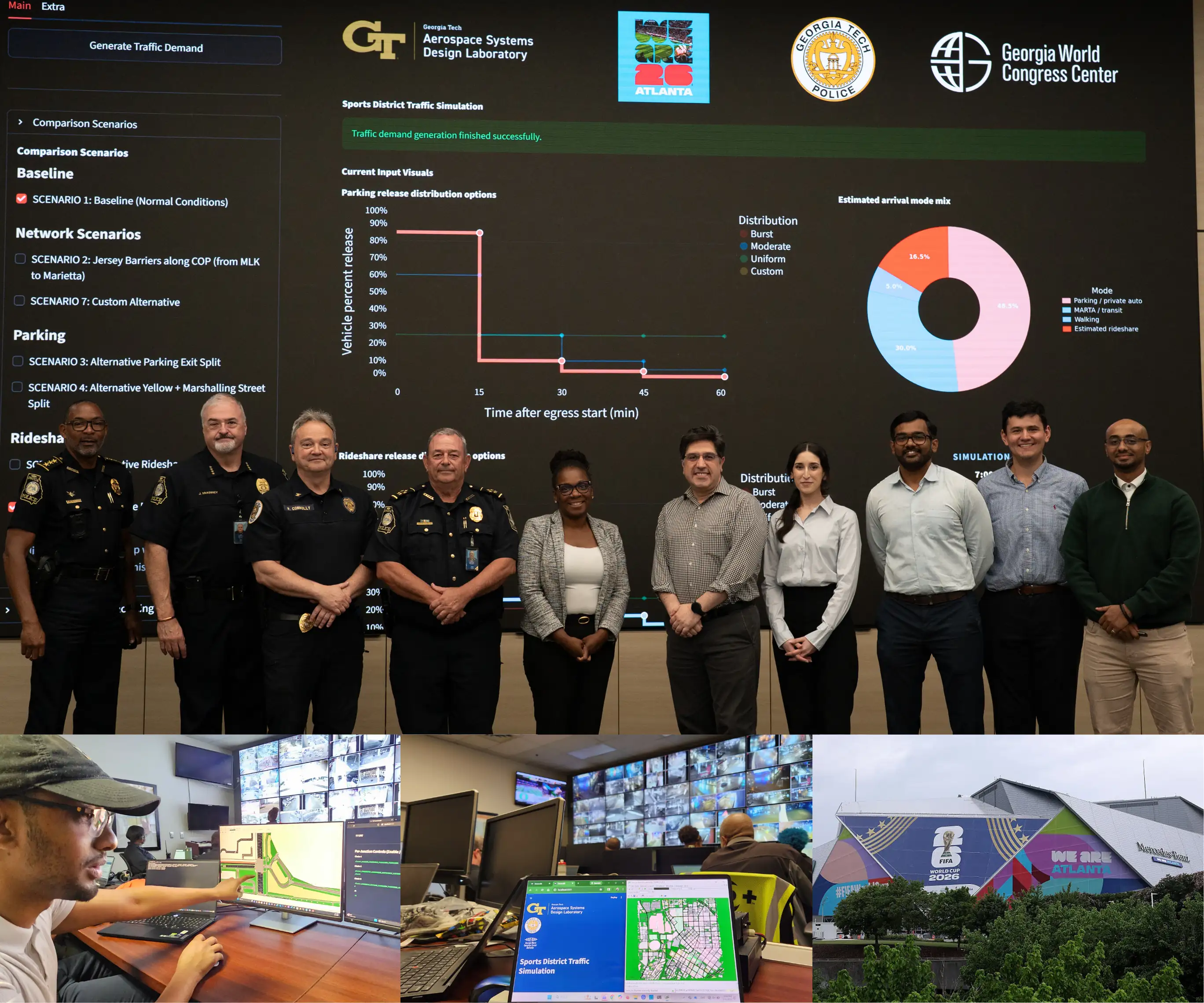
Atlanta is ready to welcome the world, and the Downtown Atlanta Convention and Entertainment District authorities are making sure every fan, visitor, and resident can have an enjoyable experience during the 2026 FIFA World Cup games.
As part of the long-standing collaboration between the Aerospace Systems Design Laboratory (ASDL) and the Georgia Tech Police Department (GTPD), a group of ASDL researchers have been closely working with the Georgia World Congress Center Authority (GWCCA) to support operations-level decisions on improving traffic plans and efficient people movement policies during the World Cup games being hosted in Atlanta. Leveraging ASDL’s data-driven simulation and digital twin capabilities, this initiative brings the lab’s years of expertise in advanced modeling for aerospace systems to the problem of people and vehicle traffic in downtown Atlanta during the games. “While it may seem surprising for aerospace researchers to work on solutions for traffic system-related decision-making problems, this effort is actually the latest initiative under the decade-long partnership between ASDL and GTPD,” explains ASDL Director and Regents Professor Dimitri Mavris.
“The partnership with the GTPD was established back in 2017 with the objective of supporting a safe, secure, and accessible Georgia Tech campus by leveraging data analytics, mobility and traffic simulation, and ASDL’s multi-attribute decision-making techniques using real campus data and information. This mutually beneficial relationship has been infusing cutting-edge research into the GTPD’s operations, while allowing ASDL to refine its data analytics and modeling and simulation capabilities,” added ASDL Senior Research Engineer and project lead Dr. Michael Balchanos. Since 2025, the collaboration has focused on delivering data-driven assessments for the campus-level impact of Georgia Tech’s new bike lanes (GT Cycle Track) and updated transportation infrastructure. ASDL has developed data-calibrated simulation tools for evaluating traffic alignment alternatives on road layouts and strategies for directing vehicle/people traffic across the campus and during various events.
With the World Cup possibly being the largest event in the city since the 1996 Olympic Games, GTPD Chief Robert Connolly along with GT’s A&F leadership decided to leverage Georgia Tech’s research capabilities to support Atlanta being one of the host cities. Besides ensuring safety and accessibility during the events, the ongoing infrastructure development in the district and difficult-to-predict crowd behavior associated with the World Cup has motivated the development of a digital twin for downtown Atlanta to help authorities anticipate unexpected situations.
Over the last year, Balchanos and a team of ASDL PhD students including Hajar Mali, Nathnael Geneti, Balaji Ravikanti, Srikanth Varadharajan and Mario Zarate have been working with the GWCCA Police Department to understand the challenges around traffic management at major events. Through a series of opportunities of “shadowing” the GWCCA public safety team at various sporting events, the ASDL team was able to better understand the problems associated with real-time traffic operations around the Mercedes-Benz stadium. One of the most important challenges identified through these field visits is monitoring and understanding the dynamic nature of safety and traffic operations within an extensive preparation context. Now strongly embedded with the GWCCA, the ASDL team has gained the necessary insights on how data-calibrated simulations and digital twins could better support the GWCC’s safety and traffic operations. Digital twins blend multiple streams of data to define district-level interactive agent-based predictive models for evaluating different traffic interventions. Through a custom-built interface, different scenarios can be built and compared in a way reflective of ongoing operations. As a real-time companion to operational views and current safety protocols, ASDL’s predictive models can assist the GWCCA in reaching consensus on tactical-level time-sensitive decisions during the games and enhancing the ability to rapidly respond to unfolding situations with improved confidence and situational awareness.
“ASDL is excited to support Atlanta during the World Cup. Our team is ready to support the deployment of this capability as the city welcomes soccer fans from around the world,” said Mavris. “This work is an investment in the future as the approach will remain as a key asset for the Georgia Tech community to improve the guest experience during mass events on campus and for the planning of future transportation solutions at Georgia Tech,” commented Balchanos.
Read the Georgia Tech College of Engineering feature here.