
ASDL Partnership with JMP Highlighted
ASDL Partnership with JMP Highlighted
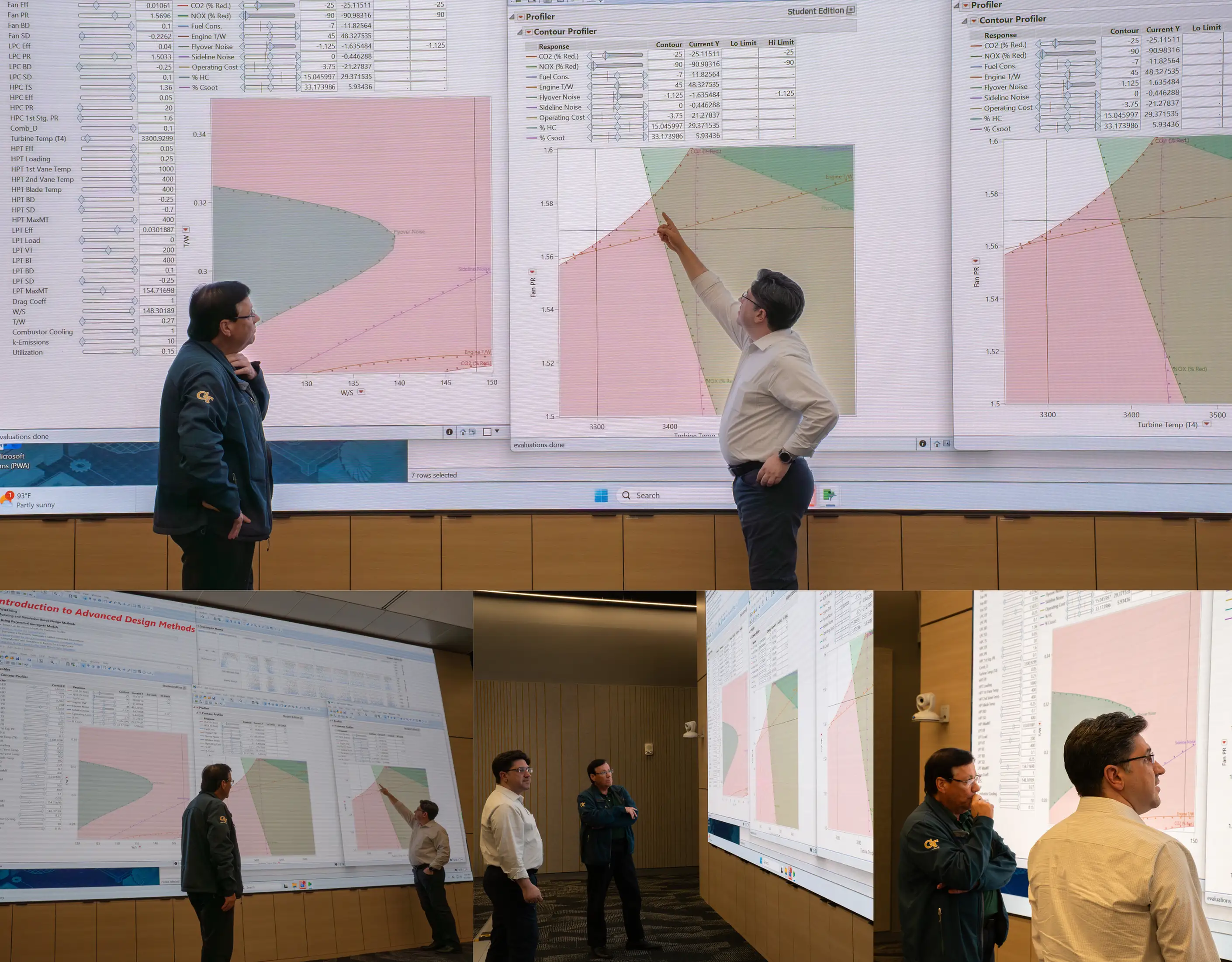
For more than three decades, the Aerospace Systems Design Laboratory (ASDL) at the Georgia Institute of Technology has equipped students to deal with complex problems. By helping graduate students explore the intersection of research, education, and industry, ASDL equips them to integrate different disciplines, cope with uncertainty, and make informed decisions in complex situations.
Professor Dimitri Mavris, Regents’ Professor and Director of ASDL, stated that ASDL could not have developed into the organization it has become without its longstanding relationship with JMP and the support and analytical capabilities JMP provides. JMP has been part of ASDL since the very beginning and is the laboratory’s primary statistical analysis environment.
For ASDL, JMP is much more than just a tool for drawing charts or performing calculations; it provides a common environment where students can integrate design of experiments, surrogate modeling, probabilistic analysis, sensitivity analysis, and interactive visualization into a single workflow.
Even as AI tools and coding assistants make it easier to generate code or automate parts of an analysis, JMP provides something different: a trusted, transparent environment where students can explore assumptions, test alternatives, and understand the reasoning behind the results.
“There’s also the aspect that whatever I’m seeing from that analysis, I can trust,” said Michael Balchanos, Senior Research Engineer in ASDL’s Digital Engineering Division and lead for its Intelligence Systems efforts. “There’s transparency. I can track the steps. The students can link the steps they took in the tool to what the theory is about.”
Read the Full story here.